












Below, Ben Rhodes shares five key insights from his new book, All We Say: The Battle for American Identity: A History in 15 Speeches.
Ben is the author of the New York Times bestsellers After the Fall and The World as It Is, co-host of Pod Save the World, a contributing opinion writer for the New York Times, a contributor for MS NOW, and a former deputy national security advisor and speechwriter to President Barack Obama.
What’s the big idea?
America is not defined by what it has been, but by the ongoing effort to decide what it should become. The most important speeches in American history challenge our nation to close the gap between its ideals and its reality.
Listen to the audio version of this Book Bite—read by Ben himself—in the Next Big Idea App, or buy the book.


1. American identity has never been a settled question.
We have been having an argument about what it means to be American ever since our founding 250 years ago. That argument has taken many different forms and addressed many different issues, but there have always been essentially two opposing stories about being American.
One of the two stories views America as inherently right from the beginning. As JD Vance recently put it, “We are not a nation devoted to a creed, but rather a particular land claimed by a particular people with a particular way of life.” At the beginning, this was white Christian settlers who formed the class of people who controlled the government, the land, and the capital. Over time, people of different backgrounds were permitted to participate in this project so long as they accepted their subordination to America’s original identity. As inheritors of a Western civilization and sense of supremacy, this exclusive American identity has also tended to view criticism of America as ungrateful or unpatriotic.
On the other hand, there’s a story that views American identity as a struggle to live up to an unkept promise, the creed written into the Declaration of Independence: a multiracial democracy founded on the idea of human equality. The struggle to live up to that idea is what has allowed the United States to abolish slavery, welcome immigrants, and extend rights and opportunity to more people. It’s a story that finds strength in diversity. And because of the self-criticism it requires, this more malleable form of American identity views self-criticism as the highest form of patriotism, and mirrors the ethos of self-improvement that we associate with the American dream.
Spoiler alert: we’re neither one story nor the other. We have always been both, and the ways in which those two stories mixed have shaped who we are. The reason our politics has become so contested and contentious in recent years is because we’re dealing with big questions about the fundamental purpose of our union and national identity. That has once again become the battleground.
2. Speeches offer a fresh lens on history.
In a democracy, a speech is the purest form of persuasion. You need to stand in front of a group of people and convince them to believe something or to do something. And the words spoken by Americans have mattered a lot. The 15 speeches I chose for this book are not necessarily the greatest hits, but rather they are speeches that have been about this question of identity. These speeches have helped spark movements or elect presidents; start wars or forged peace. Often, they reinterpreted or sometimes even reinvented the past. Some of them even foretold the future. Some of these are speeches you’ve heard of, like Lincoln’s second inaugural address or Martin Luther King’s “I Have a Dream” speech, but some of them have been lost to history. But when you go back and read them, you see how they entered our national subconscious.
What makes a speech matter? A speech has to be authentic. The speaker should be the only person able to deliver it. What is said matters, but why it’s being said matters even more. For each speech in the book, I spend time with the life story of the speaker to understand where their voice came from, what experiences shaped them, and what their motivation was to take a stand.
“What is said matters, but why it’s being said matters even more.”
I believe the alchemy of democracy is the interaction between movements and power, and each speech in my book emerges out of a particular movement for racial or gender equality, for state’s rights or white supremacy, for immigration or nativism, for a race to the future or return to the past. So, for each speech, I also spent time with the movements that made the words possible.
How Americans speak has changed with technology. In the days of our founding, a speaker would only be heard by the people in the room, and the words would then be disseminated by newspapers. This favored carefully constructed arguments. In the 19th century, when a speaking circuit emerged, performance started to matter. Politics merged with popular culture. Then radio made it possible to reach a mass audience, which favored plain-spoken explanation. Then television elevated setting, spectacle, and charisma. Then the internet and social media built online community and prized virality.
So, in place of storytelling, now, as anyone with a phone knows, moments start to matter more than stories. And precisely because we live in a time when speeches have receded from the discourse, it’s a valuable time to understand our history through them because they show the changing ways in which Americans have made arguments and told stories about who we are.
3. The compromises made at the dawn of American identity.
The book begins with Benjamin Franklin’s closing argument at the Constitutional Convention. It’s a wonderful speech filled with humor and the wisdom gained over Franklin’s extraordinary life. Remarkably, he says almost nothing about the Constitution itself. His entire argument is about the virtue of compromise, which was required to create a union among 13 states with different interests, different people, and different ways of life.
Viewed from one perspective, that compromise created one of the most successful constitutions in history, a political system and nation that would grow into one of the strongest in history.
From a different perspective, the compromises glossed over fundamental questions: the future of slavery, the role of immigration, the way our nation would grow and govern an increasingly large and diverse geography and population. Precisely because speeches are in the present tense, you can see that people knew all of this at the time. Franklin knew. That’s why one of the first public actions he took after the Constitution was to petition Congress to abolish slavery.
“From a different perspective, the compromises glossed over fundamental questions.”
The second speech in my book is by Red Jacket, a Seneca chief who spoke viscerally about how Native peoples were excluded and threatened by the new nation. The third is by Maria Stewart, an impoverished black woman who demanded abolition and the empowerment of African Americans and women. The fourth is Alexander Stevens, the vice president of the Confederacy, who declared white supremacy to be the cornerstone of his new nation. And then the fifth is by Abraham Lincoln, who radically sought to usher in a second founding of the United States in his second inaugural address.
And on and on it goes from there. Americans have always known that who we are is not a settled matter. Compromise made the United States possible, but it also set in motion all the arguments that were to come.
4. American identity has been shaped by movements.
Movements and their backlashes remade the nation in ways that weren’t apparent at the time. At the height of Reconstruction, Frederick Douglass spoke on behalf of radical Republicans. He defended Chinese immigration as both just and inevitable if America was to truly become a multiracial democracy. On the surface, Douglass failed. Reconstruction was soon over. Segregation was in place. An exclusion act slammed the door on Chinese immigration. Viewed from today, however, Douglass’ words were prescient. They entered the American subconscious. Look at our demographics. Look at the type of our nation today. It’s a lot more like the nation Douglass described than his opponents would have wished for at the time.
Or consider Mary Elizabeth Lease. She was a Kansas populist. I found a speech in which she excoriated a country ruled by and for Wall Street. She called for what we could see as a left-wing economic program while embracing a right-wing form of identity politics: the political reconciliation of the white working class, a nativist approach to race and immigration. Her words anticipated the Progressive Era of the early 20th century. They also anticipated Donald Trump.
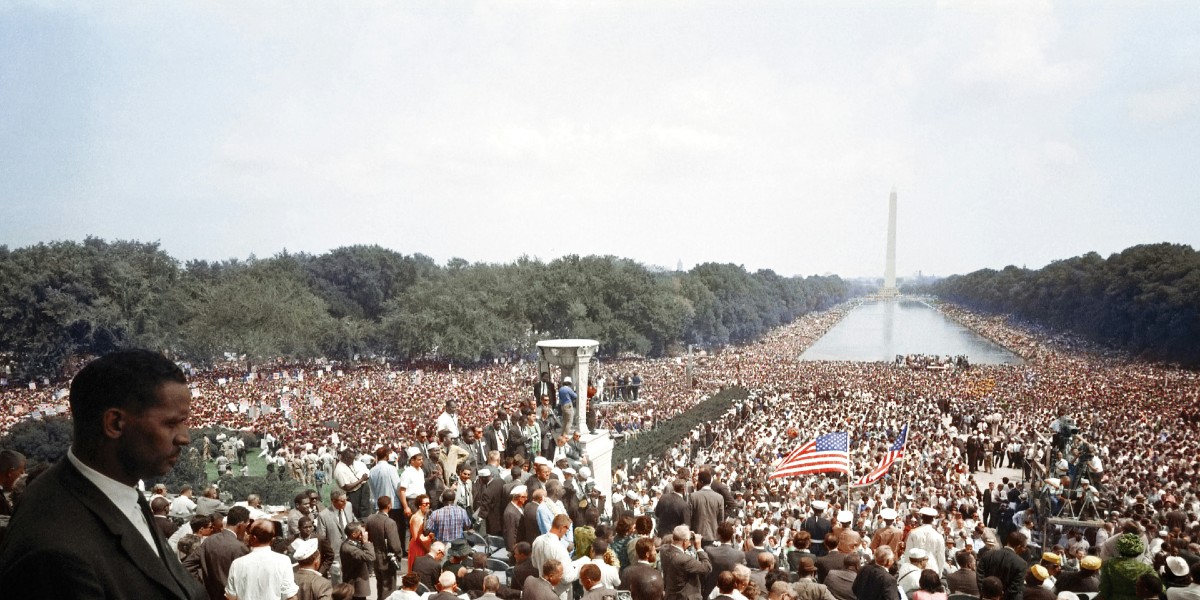
And then there’s Martin Luther King. His speech at the March on Washington helped force the issue of civil rights onto the national agenda in ways that led to the end of segregation. That movement remade America. It also sparked a backlash—a conservative counter-revolution that has continued to this day.
“Viewed from today, however, Douglass’ words were prescient.”
The book ends with consecutive speeches by Ronald Reagan, Barack Obama, and Donald Trump. It’s a dizzying ride. Each one of these presidents built a movement that was, in many ways, a response to the previous one. What separates Trump and makes this moment different is the message in his second inaugural address, which ends my book. In it, he basically declares that American identity is embodied in him. So, he doesn’t need to follow the same rules as everybody else. Those who disagree are not opponents, they’re enemies. But just like all the other speeches, Trump’s is not going to be the last word.
5. We need to recover storytelling through speeches.
To paraphrase Walt Whitman, America has always contained multitudes for good and bad, and the passage of time does not inevitably bring progress. Yes, the United States has grown bigger, richer, and more powerful, but that success does not mean that we’ve inexorably become better.
Indeed, the most powerful words spoken by Americans highlight the gap between who we are and who we aspire to be and demand that we close that gap. We live in a cynical time. If you’re like me, you can feel like you’re surrounded by forces that you lack any control over. There’s an algorithm that shapes what you see on your phone. There’s a bunch of oligarchs that seem to control all wealth and power. The old order is unraveling internationally. Artificial intelligence is coming for our jobs. It seems like there’s corruption everywhere. Truth itself is distorted or contested. But that’s why we so desperately need to find words that will help us understand why and how America can move in a new direction.
When we lack a shared national identity, we need storytelling: speeches that reimagine what binds us together. When people are being demoralized by cynicism and apathy, they need someone to stand in front of a crowd and tell them why what is happening matters and what we can do to make things change.
Enjoy our full library of Book Bites—read by the authors!—in the Next Big Idea App: