












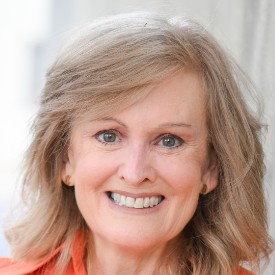
Below, Allison Aubrey shares five key insights from her new book, Your Turn: How to Create a Midlife You Love.
Allison is a longtime science and health correspondent for NPR and a contributor to CBS News Sunday Morning. She is known for her award-winning coverage of nutrition, aging, and well-being, including her ongoing “How to Thrive as You Age” series.
What’s the big idea?
Have you ever had a rope-swing moment? You’re suspended in midair, you can see the water below, and you know it’s time to let go—but you’re afraid. That’s midlife. We cling to the familiar, to the status quo, even when something better is waiting on the other side. Your Turn is a playbook for moving forward when you’re asking “what’s next?”—and for optimizing your health along the way by focusing on the longevity hacks hidden in plain sight.
Listen to the audio version of this Book Bite—read by Allison herself—in the Next Big Idea App, or buy the book.


1. Midlife is your second adolescence.
Last summer, my teenage daughter walked into the kitchen while I was at my laptop, slurping my coffee. She gave me a side-eye, harrumphed, and finally said, “Stop looking at me.” I felt a small sting of rejection—and then I caught myself. She is doing her job. Adolescence exists to push kids toward three essential questions: Who am I? What is happening to my body? What is my purpose?
And then it hit me: I was asking the exact same questions. She was navigating the hormonal upheaval of puberty; I was navigating the hormonal shift of menopause. We were both in the thick of an identity renegotiation.
In Your Turn, I lean on developmental psychologist Erik Erikson’s framework to reframe this transition as a second adolescence—not a crisis, but a necessary passage. People who face these questions head-on, as uncomfortable as they can be, are the ones who make the most incredible midlife pivots. The discomfort isn’t a sign that something is wrong. It’s a sign that something important is happening.
2. Midlife is a crossfade, not a slow fade.
When I left the NPR newsroom for what I called my “curiosity tour”—a kind of adult gap year—I was a little scared about what I might find. I had spent 12 hours a day in present tense: always on deadline, always asking what the newsroom needed, what my kids needed. I was completely out of practice at asking what I liked, or what brought me joy.
“They didn’t stumble into a joyful next chapter—they planned for it.”
I’d watched colleagues and neighbors retire and struggle, because so much of our identity and purpose is wrapped up in work. So I set out to find people who were not struggling—people who were thriving. I interviewed more than 150 people making extraordinary midlife pivots. A lawyer who opened a bespoke bookshop. A magazine editor who became an improv performer in her 60s. A former scientist who started a community of “weed warriors.” People who were oozing with energy and momentum.
What they all had in common was intention. They didn’t stumble into a joyful next chapter—they planned for it. They knew their values, they knew their strengths, and they knew how to parlay what they’d built in one chapter into something new. There is so much life beyond parenting and the paycheck. But you have to know your why.
3. Rip up the societal script.
We’ve all been handed the same three-chapter story: learn, earn, retire. And I’ll be honest—I don’t hate the concept of retirement. But I hate the word. “Tired” is right there inside it. And I don’t think it’s time to be tired.
When I look around, I see women in their 50s, 60s, 70s, and 80s—my own mother among them—who are still creating, still showing up, still asking how they can make a difference. The old script doesn’t fit that reality.
So I propose a new script: learn, earn, return. Return to the playful kid inside you who knows how to laugh. Return to the hobbies you set aside, the causes you care about, the things you never had time for. This isn’t a consolation prize for getting older. It’s an invitation to write a chapter that actually belongs to you.
4. Purpose is the longevity hack hiding in plain sight.
Everyone is talking about anti-aging elixirs, supplements, and the latest research into what slows down biological aging. And yes, diet, exercise, and sleep all matter enormously. But I think the most underrated longevity factor is purpose.
“Your immune cells know when you have a sense of purpose.”
I know, I know. Purpose is an overused word, and it makes people nervous. They picture their friend who does medical mission work or the colleague who started a nonprofit. They think, those are the people with purpose—not me. But that’s not what purpose means. If you can wake up and answer yes to the question, “Does my life have a sense of direction?” you have purpose.
And your immune system is paying attention. Researchers at UCLA drew blood from women who were isolated, disconnected, and lacking a sense of direction. What they found was striking: the genes that control inflammation were turned up, while the genes that govern the antiviral response in their white blood cells were turned down. Then those same women became volunteers at a school, mentoring kids, eating lunch together, and laughing. After 10 months, the researchers drew blood again—and found the exact opposite pattern. Your immune cells know when you have a sense of purpose. They know when you have a sense of connection. All of it ties directly to better health and, potentially, a longer life.
5. Embrace your third turn.
I grew up in Louisville, Kentucky, and when I was 13, my grandfather took me to the Kentucky Derby at Churchill Downs. A horse at the back of the pack made a sudden, unexpected surge forward—right at the third turn of the track—and went on to win the race. I turned to my grandfather, thrilled and confused. He said, “Allison, you always watch the third turn. That’s where something unexpected happens.”
“Many of us in this third quarter have decades ahead, and so much still to contribute.”
I asked him why. He thought about it and said, “When you can see the home stretch, it creates a sense of urgency.”
At 13, that didn’t land as a midlife metaphor. But when I returned to the Derby at 50, the same thing happened—and my grandfather’s words came rushing back. The third turn. It correlates with what I think of as the third quarter of life: roughly ages 50 to 75, at a time when living to 100 is increasingly possible. There will be an estimated 3.7 million centenarians by 2050. Many of us in this third quarter have decades ahead, and so much still to contribute.
The people I interviewed for Your Turn—the nonprofit CEO remaking healthcare, the Capitol Hill staffer who became a certified forest bathing guide, the engineer who trains puppies for Canine Companions, and the nurse practitioner who became a lead singer in her 60s—their stories didn’t just inspire me. They changed what felt possible. This isn’t about performing for the cheering fans in the stands. It’s about finding your own surge of energy, your own momentum, and writing the script that’s truly yours.
Enjoy our full library of Book Bites—read by the authors!—in the Next Big Idea App: