














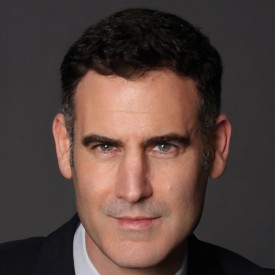
Below, Jonathan Alpert shares five key insights from his new book, Therapy Nation: How America Got Hooked on Therapy and Why It’s Left Us More Anxious and Divided.
Jonathan is a psychotherapist with two decades of clinical experience. He regularly appears on television, having provided analysis on The Today Show, Good Morning America, Fox News, NBC Nightly News, and CNN. His commentary is also regularly featured in major national publications such as The New York Times, Newsweek, and the Los Angeles Times.
What’s the big idea?
Modern therapy culture often mistakes understanding yourself for changing yourself. In doing so, it can weaken the resilience and agency that therapy is supposed to build.
Listen to the audio version of this Book Bite—read by Jonathan himself—in the Next Big Idea App, or buy the book.


1. The rise of forever therapy.
More than a decade ago, I wrote a New York Times op-ed, “In Therapy Forever? Enough Already.” The argument was simple: therapy, as it was increasingly being practiced, was not helping patients move forward. In many cases, it kept them stuck.
I remember one new patient who captured the problem clearly. He had been in therapy for several years and was beginning to question whether it was helping. When he asked his therapist about spacing out sessions or trying a different approach, the response was immediate: “If you stop seeing me, you’ll get depressed.”
That wasn’t clinical judgment. It was a warning. And it worked.
What he had been offered as care had quietly become dependency. The message was not “you’re getting stronger.” It was “you can’t function without me.” That kind of framing doesn’t build resilience. It undermines it.
After hearing that story, and many others like it, it became difficult to ignore what was happening inside my own profession. A model of therapy that should have been oriented toward independence was, in too many cases, reinforcing reliance. Patients weren’t being helped to move through their problems. They were being conditioned to return to them, week after week.
From where I sat, this wasn’t a marginal issue. It was a shift in the culture of therapy itself. And in some cases, it wasn’t just failing to help people. It was making them worse.
That article served as inspiration for Therapy Nation. In the decade since it was published, the problems have only grown worse. Therapy has gone mainstream, becoming more culturally accepted, less stigmatized, and more widely accessible than ever before—all of which should have been good news. And yet, rates of anxiety and depression remained stubbornly high. The point of good therapy is to achieve growth, agency, and strength—not to endlessly dwell on our past and stay stuck. Somewhere along the way, therapy had become one of the only services people kept returning to without demanding results.
The pattern was familiar: patients would go in each week, vent about their frustrations, feel temporary relief, and return the next week to do it all over again. They felt better walking out of the office, only to fall back into the same arguments, avoidance, indecision, resentment, or fear as soon as real life resumed. The next session became another chance to unload rather than an opportunity to learn how to change anything.
“The point of good therapy is to achieve growth, agency, and strength.”
People began confusing length of treatment with depth, mistaking hours spent talking for proof that real change must be happening somewhere beneath the surface. While sessions continued, relationships went unaddressed, decisions were postponed, and ambitions stalled. The years people believed they were “working on themselves” were often the years they stopped fully living. The longer someone stayed in treatment, the harder it became to ask the most obvious question: Is this actually helping?
In some circles, long-term therapy has become a badge of sophistication, a signal of emotional seriousness and self-awareness. But sounding psychologically literate is not the same thing as growing. Endless introspection had taken on a kind of moral prestige that had little to do with actual change. And perhaps the most striking paradox: people became increasingly fluent in describing their own patterns, yet still avoided the hard conversation, the difficult decision, the necessary risk. Insight had become a substitute for change rather than a catalyst for it.
My critique of forever therapy had widened into an examination of how a therapeutic mindset was reshaping the culture itself, shaping how Americans argued, parented, dated, worked, and even voted. People increasingly approached ordinary life the way some long-term patients approached treatment: every setback needed interpretation, every difficult feeling demanded a backward search for origins.
That paradox became the foundation of Therapy Nation: how did a tool designed to restore agency weaken it? The answer lies in a culture that increasingly prefers endless understanding to difficult changes. Once that preference became normalized, forever therapy stopped being a clinical concern and became a national norm.
2. How training programs lost the plot.
One of the most unsettling developments I’ve watched over the years is what’s happening inside therapy training itself. Graduate programs are increasingly producing not clinicians, but political activists with therapy licenses.
At its best, training demands that a therapist suspend judgment, resist the first satisfying explanation, and stay open to complexity. You are taught to be curious rather than certain, disciplined rather than reactive. To sit with a patient’s pain without immediately assigning blame. To challenge a narrative without abandoning compassion. That is what makes therapy work.
And it’s exactly what is now being lost. In too many places, students are taught a political lens before a clinical one, encouraged to interpret suffering first through identity, power, and oppression before ever examining agency, behavior, or the role a patient may be playing in the problem. Many young clinicians are primed to affirm rather than test, feeling compelled to view patients as either oppressed or oppressor, sorting by race, gender, and sexual orientation before they’ve fully understood the individual in front of them.
The therapist stops asking the most psychologically useful question: What part might you be playing in this pattern? And instead, begins reinforcing ready-made explanations that flatter the patient’s first interpretation. This robs therapy of its potential transformative power. Growth almost always requires some self-reckoning. It means asking whether our narratives are accurate, whether our grievances are exaggerated, and whether we are using ready-made explanations to avoid looking at our own patterns.
The profession has stopped asking: What is happening in your life, and how can we help you move forward? Instead, it now begins with a different question: Where do you fit in the hierarchy of power and oppression? Therapists trained to see people primarily through social justice categories can begin sorting patients into boxes from the start. Once that happens, therapy risks reinforcing identity scripts instead of helping people examine their own patterns, blind spots, and responsibility.
“Growth almost always requires some self-reckoning.”
The habits taught in graduate programs don’t stay in the classroom. They shape how millions of people will eventually understand their own conflicts, relationships, and suffering. A generation of clinicians trained to sort before they listen, to affirm before they examine, will produce a generation of patients who never learn to question their own narratives. When a helping profession teaches people to see themselves first as categories rather than individuals, the larger culture eventually begins to do the same.
3. When politics entered the therapy room.
Politics has always shaped people’s stress, anxieties, family dynamics, and sense of safety. But in recent years, I began noticing politics is becoming the primary language through which many interpret their emotional world. Patients came in describing family conflict, friendship ruptures, workplace tension, and marital strain, only for those experiences to be filtered almost immediately through a political lens. A painful holiday dinner, a strained conversation with a parent, or a friendship under stress became proof that the other person was toxic, unsafe, irredeemable, or psychologically disordered because of how they voted.
People began cutting parents, siblings, friends, and even adult children out of their lives over politics, and on national television, so-called mental health experts openly advised them to do it, turning estrangement into a form of therapeutic wisdom. In some cases, therapists themselves refused to treat patients simply because of who they had voted for. Family bonds, long friendships, and years of shared history were suddenly reduced to a vote cast in November, without asking why the disagreement felt so threatening, whether older wounds were being stirred up, or whether the conflict reflected something deeper than politics. What might once have been approached as conflict to understand and work through was now increasingly framed as a mental health necessity.
Universities rolled out counseling resources, group processing sessions, and wellness programming as though the ordinary shock of an election result had become a mental health emergency. That response helped teach people to interpret political disagreement as personal harm and ideological difference as emotional danger. In many places, the message was unmistakable: political disappointment was something people needed therapy for to survive.
Therapy should be one of the places that helps people build that capacity, not lose it. Once people learn to interpret distress through ideological sorting, they begin applying the same habit to marriages, workplaces, friendships, and family systems. We need to get back to a culture where neighbors can disagree politically and remain friends, and where family and friendship are strong enough to outlast any political cycle. The ability to tolerate disagreement, question first impressions, and resist turning every conflict into a moral referendum is essential for a functioning society. We are losing it.
4. How therapy-speak took over culture.
Therapy-speak has escaped the clinic and lost much of its meaning. Words like toxic, gaslighting, boundaries, trauma, and narcissism were developed as clinical tools. In everyday conversation and on social media, they’ve been weaponized, used to win arguments, avoid criticism, and cast ordinary conflict as abuse. The result is that ordinary life begins to feel more pathological than it really is, and people become more likely to interpret frustration, conflict, or personality differences as signs of diagnosis rather than normal human experience.
A disappointing friend is called toxic. A selfish ex becomes a narcissist. A misunderstanding at work turns into gaslighting. An uncomfortable request becomes a boundary violation. A painful memory becomes trauma. These words were originally useful because they described serious, specific patterns, but when they become shorthand for every unpleasant experience, they stop clarifying reality and start distorting it.
Once therapy-speak becomes the dominant way people narrate relationships, the threshold for what counts as ordinary friction is reduced dramatically. Everyday disagreement starts to feel dangerous. Ambiguity feels intolerable. Every conflict is problematic. There is something particularly corrosive about vocabulary that makes people feel more sophisticated while actually making them less accurate.
“Everyday disagreement starts to feel dangerous.”
Patients often arrive with polished stories already built around therapy-speak: they know who the villain is and have the vocabulary to frame themselves as harmed. Clinical language, when misused, gives people a sophisticated language for grievance without any framework for resolution. Once someone decides whether a friend is toxic or a partner is a narcissist, the label itself shuts down any alternative explanation. The conversation is over before it begins.
One of the clearest signs of this shift is how often the phrase “my therapist says” now functions as the ultimate conversation-ender. It gets repeated almost like a moral trump card, a way of shutting down disagreement by borrowing the authority of therapy itself. Part of what makes this language so seductive is that it offers immediate validation. But when a culture mistakes validation for progress, emotional comfort can quietly replace the harder work of self-examination.
The healthier use of psychological language is not to turn ordinary life into pathology, but to clarify genuine patterns that help people respond more effectively. Used carefully, these words can deepen insight and strengthen relationships. Used casually, they trap people inside distorted narratives and keep them stuck. Good therapy sharpens perception. Therapy culture, at its worst, can blur it.
5. The pathologizing of ordinary life.
The final and perhaps deepest consequence of therapy culture is the way it has encouraged us to reinterpret ordinary life through the lens of pathology. Every generation has had language for suffering, but what feels different now is how quickly normal human experiences are elevated into symptoms, syndromes, or psychological injuries.
Everyday disappointment becomes trauma. A difficult boss becomes abusive. A moody teenager is labeled disordered. A breakup becomes evidence of emotional damage. Ordinary anxiety becomes proof that something is wrong. This shift may seem compassionate on the surface—and that’s precisely what makes it so costly.
The more we pathologize normal life, the less prepared people become to handle it. Life is filled with discomfort. Rejection, frustration, uncertainty, heartbreak, and criticism are not signs of dysfunction. They’re very much a part of life. They are also the raw materials from which resilience, maturity, and growth occur.
When culture teaches people to interpret these experiences primarily as threats to mental health, something essential begins to disappear: frustration tolerance. People become more vigilant toward discomfort and less willing to ask what discomfort might be teaching them. The issue is whether we are helping people become stronger in the face of life’s inevitable difficulties or whether we are unintentionally training them to experience more of life as dangerous.
“The more we pathologize normal life, the less prepared people become to handle it.”
Some of the most important capacities we develop as adults come from learning that we can survive what we do not like. We survive embarrassment. We survive disappointment. We survive being misunderstood, criticized, rejected, or uncertain about what comes next. Those experiences are how character is built. When therapy culture encourages people to monitor themselves too closely for signs of injury, it can accidentally make those ordinary experiences feel more destabilizing than they need to be.
Real mental health is not the absence of pain. It is the ability to move through pain and the ability to separate temporary discomfort from actual damage. The future of mental health depends on helping people recover a basic truth: discomfort is often the beginning of growth, not a sign that something has gone wrong.
Feeling understood is not the same as getting better. Modern mental health culture has drifted toward treating validation as progress, but real progress is often uncomfortable. The hopeful alternative is courage: a vision of mental health grounded in greater capacity, not the avoidance of discomfort. The real measure of growth is not how well someone can describe their wounds, but how confidently they can move through the difficulties that every meaningful life will encounter. That is what allows people to truly flourish.
Enjoy our full library of Book Bites—read by the authors!—in the Next Big Idea App: