













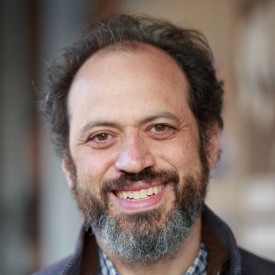
Below, Ethan Mollick shares five key insights from his new book, Co-Existence: The Next Phase of AI.
Ethan is a professor at the Wharton School of the University of Pennsylvania, where he studies AI’s impact on work and education. He is the bestselling author of Co-Intelligence and writes the newsletter One Useful Thing.
What’s the Big Idea?
AI is advancing faster than our ability to understand it, and the way we work, learn, and organize our lives has yet to catch up. We can’t afford to stand still. We have to rethink how we do things to take advantage of AI’s growing capabilities while navigating its weaknesses.
Listen to the audio version of this Book Bite—read by Ethan himself—in the Next Big Idea App, or buy the book.


1. AI is probably better than you at something, but nobody knows what that is.
In 2022, just before ChatGPT came out, the world’s top forecasters were asked to predict when an AI would win a gold medal at the notoriously challenging International Mathematical Olympiad. They gave it a 2.3 percent chance of happening by 2025.
That seemed like a reasonable prediction because AIs couldn’t count the number of Rs in the word strawberry, but by 2025, both Google and OpenAI got gold medal status at the International Mathematical Olympiad. And right now, AIs are solving very complex mathematical theorems that have been unsolved for 83 years.
How do we go from a model that was once really bad at math to one that is good at math? Why was it bad at math, but good at other things? That’s what we call the jagged frontier. It’s a term we coined for the idea that AI is good at some stuff, bad at others, and you can’t tell which.
Imagine there’s a wall around what AI can do. You expect a smooth circle with easy things inside the boundary and hard things outside, but it’s actually a jagged perimeter. Some trivial tasks sit outside it, but now things like the Math Olympiad sit inside. And the AI gets more jagged over time because abilities grow unevenly.
This can lead you to two different traps. The first trap is that you might watch AI do something impossible and assume it can do everything. We did a study where we found that consultants who used AI a lot stopped paying attention, started using AI for things it wasn’t good at, and therefore made more mistakes. But it’s also possible to watch AI fail once and then write the whole thing off. You can still see people who say, “I tried AI and it doesn’t work really well.” You have to hold both ideas at once. You have to believe that AI is both genuinely powerful and genuinely unreliable, and you have to use your judgment to know which side you are facing.
2. There is a new way to work with AI.
In my first book, I talked about centaur and cyborg work. Centaur work was like the half-human, half-horse: cleanly divided between what was AI and what wasn’t. So maybe you delegate particular tasks to AI, like writing code, and then do analysis yourself. Cyborg work was about weaving back and forth between what you did and what the AI did. You’d blend the two things together, and that was a more advanced use case.
“Increasingly, AI use is about delegating work to the AI to accomplish things.”
But with the advancement of long-running AI agents, there is a new mode of work which I call Manager. It’s about defining the task, handing it off, and then evaluating what comes back. Increasingly, AI use is about delegating work to the AI to accomplish things. What makes you good at using AI now isn’t knowing particular magic words or prompts. It’s really about being a good manager. If you can write a clear task definition or creative brief, or if you have project management skills, then you can probably work with an AI agent right now.
3. Know when not to use AI.
There have been a bunch of studies and debates about whether AI damages your brain, and I can tell you that it doesn’t literally damage your brain. You’re not going to get brain damage using AI, but we need to actively make choices about when to use AI systems and when not to.
When we choose to use AI, we are not necessarily learning. We are not necessarily using our brains. We’re often giving up that part of our knowledge or information, but that’s not necessarily a bad thing. My grandfather built launchpads at Cape Canaveral with a slide rule and I can’t use a slide rule at all. I don’t regret that, ever. So I’ve given up slide rule skill in order to have calculators or computers do things for me. So it’s not really about using your brain or not. It’s about being intentional about when you’re using these systems.
Helpful systems, like AI, answer questions for you. My colleagues at Wharton did a study of high school students in Turkey, and they found that students who used AI to get answers to questions on tests received worse scores. Even when they thought they were learning something, the AI was giving them hints about how to do it. But if you use AI intentionally, like as a tutor—as demonstrated by a follow-up study they did in Taiwan—then people perform better on tests.
It’s really about thinking about how to use AI in the right way for you. So don’t necessarily use it when you want to learn, because that’s a time when struggling is the point. For example, for every chapter of my book, I write by hand first before ever talking to an AI because I’m worried its ideas will come to dominate my own. I want to make sure that I maintain that humanity.
4. Caution without action is its own kind of failure.
I sometimes make people so worried about AI use and de-skilling that they never use AI at all. They spend hours on work that an agent could do for them. But you want to think about patterns where the AI reliably pays off.
One of those is where you need quantity to find quality. A place where that happens a lot is ideation. If you want to come up with the best ideas, you first have to come up with a lot of ideas and then select among those or recombine them to find the best possible idea. AI is pretty good at ideation. In an experiment done by some of my colleagues at Wharton, they had GPT-4 (a now obsolete AI model) generate 200 startup ideas. They had their startup class come up with 200 startup ideas. Then, external judges ranked these ideas by willingness to pay. 35 out of the 40 best ideas, as judged by other humans, came from the AI.
“AI is pretty good at ideation.”
Another pattern is when you need to keep moving. When writing my book, there were points when I would get stuck and I would write to the AI: give me 30 ways to end the sentence, give me 40 ways to think about this problem. And I got to select among those. Often I would reject all of them, but it helped keep me going.
It’s also worth using AI whenever its output can be checked against reality. Like if you write code, either it was written correctly and it will run, or it is wrong and won’t work.
For softer issues in which human skills matter, AI involvement can become more complicated. You need to think about using AI when the gap between yourself and an expert is quite large and when you think that you can gain something by unsticking yourself and moving forward. I’m a pretty good writer, but I’m also a bad graphic designer, so I get really big gains out of using AI for graphic design work and smaller gains from using it for writing. You’ll have to think about what your own jagged frontier is to make the right decisions about using AI.
5. Everything has changed, but nothing has changed.
In the past year of using AI assistance—though all the ideas are mine—I’ve written more academic papers, and higher-quality ones, than in the previous five years combined. Yet this very week, I got another set of emails from my employer, the University of Pennsylvania, asking me to fill out different forms and take various mandatory trainings—all things I still have to do by hand. A lot has changed, but nothing has changed.
Penn was founded by Ben Franklin. It predates the Industrial Revolution. It’s not adapting quickly to this particular revolution. That’s a problem we see everywhere. AI is transforming personal work, but it hasn’t yet transformed how work operates.
“A lot has changed, but nothing has changed.”
One reason is something called the O-ring theory, rather grimly named after the Challenger, which had thousands of things go right in its launch, but had one bad seal, one bad O-ring, that caused a disaster. Quality depends on weak links, and that’s why the jagged frontier matters, because if your AI system has a weakness and you don’t have humans to plug that weakness, then that’s enough to make AI not useful.
We did an experiment at Procter & Gamble with 776 professionals, and we found that one person using AI matched a two-person team without AI. But even more interestingly, the walls between teams started dissolving. Technical people did business work, and businesspeople did technical work.
The AI that’s available when you hear this is better than what I wrote about. So you need to go and experiment with it yourself. You need to figure out what AI can do for you as somebody who’s working with these systems—what it does for your job, for your industry. You have to start thinking about how we change how we work, how we educate, and how we think to take advantage of the good parts of these systems while avoiding their weak spots. The world is changing quickly, but also slowly, and we need to adapt along with it.
Enjoy our full library of Book Bites—read by the authors!—in the Next Big Idea App: