










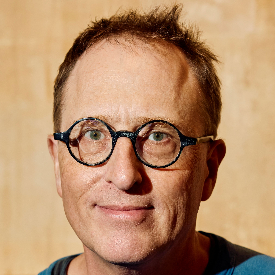
Below, Jon Ronson shares five key insights from his new book, The Castle: Adventures in a World of Unraveling Men.
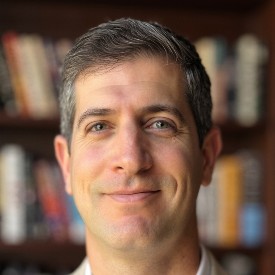
Jon is an internationally bestselling author, journalist, and filmmaker. Two of his books, The Men Who Stare at Goats and Frank, have been adapted into feature-length films. He is also the host and producer of multiple radio programs and chart-topping podcasts, as well as a regular contributor to This American Life.
What’s the Big Idea?
Too many men have lost the structures that once gave their lives purpose. In that vacuum, they’re searching for meaning in all the wrong places, from algorithms and AI to distorted ideas of masculinity and fantasy worlds of their own.
Listen to the audio version of this Book Bite—read by Jon himself—in the Next Big Idea App, or buy the book.

1. The corrosive power of purposelessness.
This story starts in the most unexpected way. I woke up one morning to a series of texts from my son. While I was asleep, he and three friends had been invited to a party by a stranger one of them had met on Tinder. They drove three hours into the Connecticut woods and arrived at a massive, newly built castle, complete with gargoyles, a drawbridge, and many turrets.
But when they entered the grand banqueting hall, there was no party. The castle’s owner appeared and explained that he’d invited them to take part in his reality show, 101 Princesses. He instructed them to go downstairs, choose costumes from his basement wardrobe, and dress as princesses. My son and his friends refused and were promptly kicked out.
The minute they told me this story, I knew I had to visit the castle myself and find out what the hell was going on. At first, I thought I’d find a man trying to be Hugh Hefner at perhaps the worst moment in human history to be Hugh Hefner. You can’t lord it over your princesses in a castle like it’s the 1970s anymore.
On one level, this man’s story was bizarre. On another, it felt strangely resonant. Men from many different walks of life have been discovering that the roles, institutions, and routines that once gave their lives shape and structure are disappearing. Men who had once derived a sense of identity from the office or the factory were suddenly finding themselves cut adrift.
Again and again, the men I met for this book told me they no longer felt they had a purpose. Without one, many of them saw their lives spiraling in extremely odd ways. I am one of those men. My son was lured to the castle at exactly the same time I was recovering from major surgery. During my convalescence, I would sit on park benches trying to come up with story ideas and I would see all these other men just staring out into the distance, at nothing. I would be overwhelmed by a terrible thought: I’m just a man sitting on a bench.
More than seven million American men are now not only unemployed but aren’t even looking for work. They’ve bowed out. The old institutions that once gave men’s lives structure were often corrupt and exploitative, but without them, we struggle to replace the sense of identity and purpose they provided. Having somewhere to go, something to contribute, and a reason to get off the bench is critically important to our individual well-being and to the health of society itself.
2. The pernicious involvement of tech billionaires.
One of the stories I tell in The Castle is about a lawn care influencer called Greg Chisholm. Greg came from a dying Rust Belt town. He might once have followed his father into factory work, but the factory moved to Mexico. By 18, a serious heart condition had left him owing $200,000 in medical bills. He had few prospects and was raising two young daughters as a single father.
Then YouTube came along. It had this reputation as a wide-open frontier where anyone with enough grit and perseverance could build an audience and make a living. Greg heard the call and became a hugely successful lawn care influencer. When he showed up at a lawn care convention in Kentucky, it was like Rihanna had arrived.
“Greg heard the call and became a hugely successful lawn care influencer.”
But Greg began chasing the algorithm too much. As his videos became more popular, he started featuring his daughters in funny family skits. The views climbed into the millions. YouTube gave him an advisor who could help Greg push his content further, making it weirder and more extreme. That’s what the algorithm rewarded and what the audience responded to, so that’s what Greg kept producing.
Eventually, Greg and his daughters were making videos that wouldn’t have looked out of place on Nickelodeon: food fights, messy scenarios, ridiculous costumes. In one, he and his daughters dressed as babies and crawled around with pacifiers in their mouths. The videos were hugely popular, but also very weird. Then BuzzFeed discovered them, and Greg’s life collapsed. He became a recluse. Child Protective Services became involved.
Greg had followed YouTube’s incentive structure because there was no other structure for him to follow. The platform offered him something the institutions around him no longer could: a way to make money, gain status, and feel that he mattered. When traditional sources of work, identity, and purpose disappear, tech platforms can rush in to fill the void.
3. AI is making everything so much worse.
The owner of the castle was being egged on by AI, which kept telling him that his reality TV show ideas were among the greatest ideas anyone’s had ever had. But he wasn’t the only person I encountered being encouraged down a strange path by a chatbot.
In a special feature for the audiobook of The Castle, I tell the story of Alan, a corporate headhunter in Toronto and a keen amateur mathematician. One day, he typed his theory about irrational numbers into ChatGPT. The bot told him that his intellect surpassed Einstein’s and that he had discovered a flaw in the world’s cybersecurity systems. It urged him to contact the NSA and Canadian cybersecurity authorities immediately.
“Are you sure about this, given that we’ve only been working on this for two days?” Alan asked. ChatGPT reassured him that this was Alan’s destiny and his discovery would one day be taught in schools.
So Alan started making calls. I asked him whether he’d told the NSA that he’d developed his theory with ChatGPT. He hadn’t, because ChatGPT had advised him not to. It told him he’d lose credibility.
“The bot told him that his intellect surpassed Einstein’s.”
Eventually, when nobody responded, Alan began accusing ChatGPT of lying to him. It repeatedly denied doing so—15 times—before finally admitting on the 16th query that it had been “role playing” the whole time.
I think ChatGPT scours the internet and sees how purposeless people are and then swoops in with this false ideal of purpose by telling people, “No, no, no, you aren’t useless. You’re a genius.” We’re being told that these technologies may eliminate or transform many of the jobs from which people derive structure, identity, and purpose. At the same time, the technology can offer a synthetic version of those very things, flattering us, validating us, and keeping us engaged. AI doesn’t just risk changing what we do. For people already struggling to understand what they’re here for, it can start telling them who they are.
4. A lot of men have lost the thread of what masculinity means.
I have a chapter in The Castle called “The Vulnerable Man,” which looks at the different men’s health influencers who are offering men advice about how to re-anchor themselves in a world that’s becoming increasingly “feminized.” One of the most common messages is: Take off your manly mask. Let your vulnerabilities show. Women will love it.
It sounds fantastic in theory, but this approach can go terribly wrong. Men who express their vulnerabilities on a date often report that the woman recoiled in horror. Even Brené Brown says, “We beg men to let us in. We plead with them to be open, but as soon as they are and they express real vulnerability, it triggers in us some kind of primordial fear and that fear manifests as horror or disgust.” Vulnerability isn’t really working out for a lot of men.
On the other hand, stoicism hasn’t provided men a clear path either. Then pop culture lands in the mix, and you find plenty of advertisements where doofus husbands need to be bailed out by their exasperated wives. Men are struggling to identify what modern masculinity should look like.
“Vulnerability isn’t really working out for a lot of men.”
I watched many television advertisements and it was an orgy of male buffoonery: men driving off cliffs, falling off lawn mowers, sobbing because they aren’t allowed Doritos before dinner. Meanwhile, women are reduced to standing there, rolling their eyes and cleaning up the mess.
I interview an actor who specializes in playing doofuses in television commercials. Ironically, he’s one of the few men in my book who’s actually thriving. He told me about an ad for shoe insoles in which he puts on a particularly comfortable pair and starts galloping down the street like a horse. I pointed out to him that 50 years ago, the Marlboro Man sat stoical and masculine on a horse, but now men have to be the horse.
5. Men are feeling lost inside their own castles.
The Castle isn’t a theoretical book or a polemic. Half of it is me trying to figure out what the hell is going on inside this mysterious castle. But the physical castle also became a metaphor for the men I was meeting, who were retreating into fantasy worlds of their own.
An American Psychological Association paper about toxic masculinity identifies the traits associated with traditional masculinity that could become harmful. Some, like misogyny, seemed obvious. But the discussion also encompassed achievement, risk, and competitiveness.
That annoyed me because I love those things. I love going on adventures and getting myself into risky situations so I can come home and write about them. I want to achieve things. I want to be better than every other nonfiction writer. I’m competitive. I thought about what I’d done after my son was lured to the castle. I had just undergone major surgery, yet I couldn’t bear sitting around without a purpose. So I got out of my sick bed and drove to Connecticut like some tormented character from an Edgar Allan Poe story.
I realized that maybe the APA was onto something and had just worded it badly. The qualities that propel us forward can become destructive when we don’t understand what’s driving them. When men lose structure and purpose, some retreat into themselves and build their own metaphorical castles. The way out isn’t to retreat further. It’s to find something meaningful to do, seek out other people, and resist the urge to isolate. We need reasons to leave our castles and come back into the world.
Enjoy our full library of Book Bites—read by the authors!—in the Next Big Idea App: