










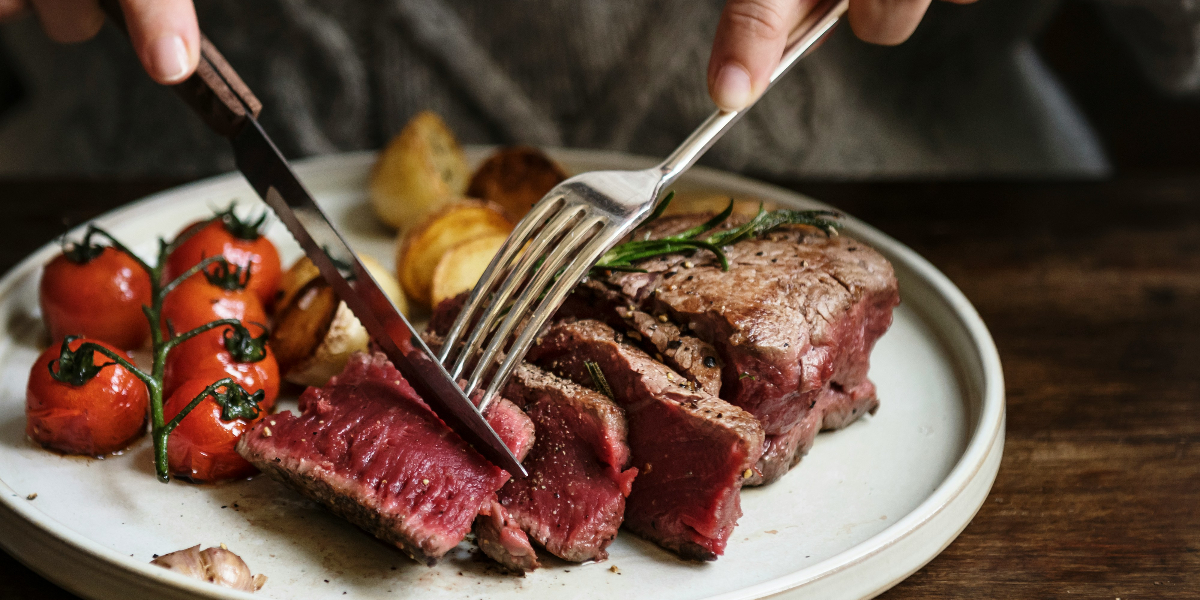

Below, Gavin Weedon and Samantha King share five key insights from their new book, Protein: The Making of a Nutritional Superstar.
Gavin is an associate professor at Nottingham Trent University in the UK, where he teaches and researches the sociology of health, food, and the body. Samantha is a professor in Kinesiology and Health Studies at Queen’s University in Canada.
What’s the big idea?
The massive protein boom shaping recent health trends has less to do with biology and more with cultural and political factors.
Listen to the audio version of this Book Bite—read by Gavin—in the Next Big Idea App, or buy the book.

1. Protein is everywhere—again.
Samantha and I have spent a lot of time in the last few years thinking about the ubiquity of protein: the dietary superstar that likely needs no introduction given just how intensively it is marketed by food conglomerates and dietary influencers.
It started with us noticing that we were each being peddled high-protein diets, without ever really soliciting this advice from anyone or anywhere, and that the health and fitness circles in which we mixed were increasingly rife with talk about protein. Eventually, our critical faculties took over: we began looking into the origins of what seemed to be a growing cultural obsession with protein, beginning with a series of questions about why and how this macronutrient had infiltrated our health and fitness circles.
Questions like:
- What exactly is the appeal of those giant plastic tubs of highly processed protein powder?
- Why do food manufacturers emphasize the protein content of their products in increasingly larger fonts?
- What keeps consumers rotating through the latest high-protein dietary regimen, from Atkins to Paleo to Dukan?
- Who needs protein added to their beer, potato chips, or ice cream?
- Why are people scared of carbs?
One of the most curious things we learned is that this obsession with protein has been with us for nearly two centuries. It began when protein was first identified as a nutritional category, and was then developed into a supplement in a form that resembles the protein-infused smoothies and shakes we have today—perhaps even less palatable. The story of how it has fluctuated in and out of dietary consciousness, about how it has been mobilized as a solution to all manner of problems both real and imagined, is the story we seek to tell.
2. Protein is a cultural obsession based on want, not lack.
Why is protein everywhere? Given the relentless peddling of protein, you might be forgiven for thinking that there is a great dearth of this stuff. You might be forgiven for thinking that the protein boom is a coordinated movement to correct a cavernous protein-shaped gap in our diets. But this kind of ‘supply and demand’ logic is seldom how food systems and dietary trends work.
It turns out that the obsession with protein has little to do with what our bodies need. Protein deficiency is extremely rare in the absence of severe hunger, and therefore almost non-existent among the consuming classes at the center of the current protein boom.
Once we accept that protein production and marketing isn’t a neat and simple means of replenishing a lack, other possibilities come into view. For example, might protein’s popularity be explained by the desire for self-optimization? Might protein have become a handy vector for packaging food as healthy or powerful or even essential without having to explain much else about what goes into it?
“Protein deficiency is extremely rare in the absence of severe hunger.”
Even protein’s most devout evangelists are starting to wonder aloud if this obsession has outsized any real relationship to the actual needs of the human body. After all, we can only consume so much!
3. Protein is confounding—and always has been.
Sometimes, the simplest questions are the ones that remain elusive all the way to the end, long after seemingly more complex or specialized matters have been settled. The questions ‘What exactly is protein?’ and ‘How much should I eat?’ are exemplary of this paradox.
The problem, for those who want their definitions as neatly divided as their macronutrients, is that protein isn’t just one thing. It’s animal flesh, or human flesh if we entertain the humbling prospect that we, too, are food for some creatures. It’s a scoop of powder, of mysterious provenance, blended into your post-workout shake. It’s the secret and the symbol of muscular embodiment, and so takes us, in a short but consequential hop, to masculinity. Its molecules swirl within our bodies and outside them, perhaps in the harbinger form of the COVID-19 spike—the viral corona protruding from its globular surface. Protein is all of these things, and more.
When faced with something with such an extraordinary capacity for shapeshifting, a common approach is to search for an essence that unites all manifestations: the silver bullet explanation, the elevator pitch on protein. But you’ll be disappointed. Ever since its coining as a nutrient, protein’s status has been contested. One of the founding fathers of protein science, the German chemist and entrepreneur Justus von Liebig, declared protein the “only true nutrient” in the mid-19th century, only to confess later, in an exchange of letters with colleagues, that it may not exist as a coherent category at all.
So, rather than joining in the pursuit of protein’s essence, where many sharp minds have run into trouble, we take a different tack. Our approach is to embrace protein’s multiplicity as we try to follow it, almost like paparazzi seeking snapshots of an elusive subject in its many guises. This approach revealed how entangled protein has been in the social worlds in which it has thrived.
4. Protein powder is—or was—garbage.
Let’s take a more granular approach to thinking about protein powder, specifically whey powder: the most popular variant of protein supplement, making up 55 percent of protein sales.
Whey powder that is sold as a vital health supplement began life as garbage. Whey is the excess of dairy products, specifically the liquid left over from making milk and cheese. In the mid-20th century, when dairy agriculture in the U.S. was industrializing rapidly, a booming cheese industry led to the production of massive quantities of excess whey. Dairy farmers faced a conundrum: in the past, they fed surplus whey to their pigs or used it as fertilizer. But the amount they were now dealing with made local recycling impossible, and they started dumping the excess on their land or into sewers, rivers, and streams. Because of its high nitrogen content (the very quality that makes whey appealing as a health supplement), untreated whey effluent is toxic to soil and aquatic ecosystems. Looking for a way to avoid environmental penalties and monetize this waste, the agrifood industry undertook a decades-long effort to transform whey pollution into a palatable, proteinous foodstuff.
“Whey is never entirely purified of its toxic origins.”
Whey industry boosters like to promote protein as the epitome of a successful techno-solution, but on closer inspection, we found that the nitrogen content that allows whey to act as both panacea and poison does not disappear in the process of commodification, or even upon digestion. In other words, whey is never entirely purified of its toxic origins. Instead, it reemerges in other guises after passing through the bodies that consume it.
This is a sweeping account of a complex story, but we hope it conveys an important point: that whey’s nutrient density presents challenges to environmental health. This problem manifests not just at the point of production, where whey powder is posited as a techno-solution, but also in the lands and waters it moves through after consumption and excretion. Whey protein powder used to be garbage. But something of its potency remains through its lifecycle.
The invention of whey protein powder ensures that the dairy industry, with its harmful environmental impact and animal welfare issues, has not only continued to make cheese in abundance but also stumbled across a lucrative new revenue stream in the process.
5. Protein is political—but not partisan.
In January 2026, when Health Secretary Robert F. Kennedy Jr. released new federal dietary guidelines, we were not surprised to see that increased protein intake, in the form of meat and cheese, was now recommended. Dietary guidelines are always political. They are taken up by governments at all levels to shape the population’s food intake, and they are the subject of intensive lobbying by business interests that have a stake in this seemingly most personal of matters: what we eat.
Protein is the subject of fierce contestation over what truly matters to people—the fear that certain ways of life, such as ranching and meat-eating, are under threat, or the belief that a sustainable future will require producing novel techno-foods that are less environmentally damaging. Welcome, in other words, to protein’s entry into the culture wars.
While protein is contentious, it doesn’t fall neatly on either side in our politically divided present. Rather, it is mobilized with equal fervor by those concerned to protect meat rearing and consumption, and by those seeking to engineer and build markets for alternative proteins.
“While protein is contentious, it doesn’t fall neatly on either side in our politically divided present.”
On one side, we have the defenders of meat across older and newer factions of the Republican right; on the other, we have liberal tech capitalists and promoters of alternative sources of protein in their many forms. Both attach their claims to the climate crisis. While Trumpian Populism has veered between open dismissiveness and outright denial of environmental breakdown, alternative protein production is premised on the real and pressing consequences of environmental breakdown, albeit without necessarily disturbing the conditions of a global food system that is in desperate need of overhaul.
In these two starkly different visions of our future, protein has managed to land a starring role in each! Maybe it’s time to rethink what should occupy the center of our dinner plates and perhaps go further to question whether this stable nutrient is really able to live up to the promises with which it is endlessly imbued.
Enjoy our full library of Book Bites—read by the authors!—in the Next Big Idea App: