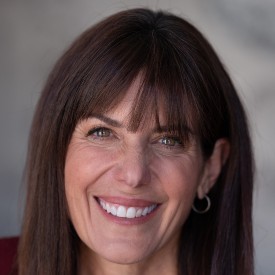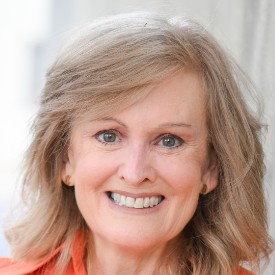












Below, Ami Fields-Meyer and Julia Angwin share five key insights from their new book, On Courage: How to Be a Dissident in an Age of Fear.
Ami is a political strategist, former White House senior policy advisor, speechwriter, and political organizer. Julia is a Pulitzer Prize-winning investigative journalist, tech reporter, and regular columnist for the New York Times opinion section.
What’s the Big Idea?
Authoritarianism doesn’t endure because most people agree with it—it endures because most people believe they’re alone. Democracy is strengthened when ordinary people trust their moral instincts, find one another, and discover that a single act of courage can spark a movement.
Listen to the audio version of this Book Bite—read by Ami—in the Next Big Idea App, or buy the book.

1. Fighting back against authoritarianism begins with listening to your gut instinct.
We call the decision points that come from following your gut moral collisions. We heard about this kind of moment from a mild-mannered lawyer inside a federal agency who was asked to do things that he thought were profoundly unethical. We heard it from a longtime MAGA supporter who started to have doubts about the movement when the governor of his state started platforming anti-vaxxers during COVID.
All of us have these moments when we think, “This really doesn’t feel right, but if I speak out and dissent, then I’ll be at risk.” Maybe it’s financial security, maybe it’s social stature, maybe it’s something more serious, but because of what we’d have to put on the line, most of us don’t follow that voice. Most of us suppress the voice because it is the easier and more natural choice for human beings to make. It’s a survival instinct.
But surprisingly, people who were most effective at fighting back against authoritarianism—and even staying safe under it—were those who didn’t suppress that voice in their heads but followed it instead.
Authoritarian conditions can put us in oppositional terms. They can define us by who and what we are not, but the most effective dissent emerges from being clear about who you are, what you believe, and what your fundamental vision for the world is. Having that clarity doesn’t necessarily make things easier, but it makes your choices clearer and helps put the risks that you might take into their proper context.
2. Dissent becomes easier and more effective when we do it with others.
Almost never in our reporting for this book did we hear about truly solitary acts of dissent. The dissidents we spoke to here in the United States and all over the world were emboldened to take risks. They were empowered to fight back by surrounding themselves with people who could take those steps with them. Many of them described what we call a political home, meaning a place to regularly gather with other people who share their values, a place to process the dizzying events of the world and strategize about what to do next.
There is something a bit strange about the idea of a political home. Think about other kinds of crises that we experience in life. We have a whole social safety net. We have doctors in case of a health crisis. We have spiritual, social, or faith communities to turn to in a personal crisis, such as losing a job, the end of a relationship, or grieving a death. For most of us, it would be crazy to try getting through any of those crises on our own. But as the U.S. is living through a massive, long-lasting season of political crisis, most Americans don’t have a political safety net. Most Americans don’t have a core political community. It’s just not part of the box set of institutions that commonly make up daily life. But it doesn’t have to be this way.
“Most Americans don’t have a political safety net.”
People all over the world are repurposing their existing networks as instruments of political resistance. When the Trump administration started coercing universities into signing what were effectively political loyalty oaths, professors at universities across the country used their faculty associations—their academic senates—to push back. When the Israeli government banned displaying the Palestinian flag, or even the colors of the flag, in the occupied territories, Palestinian women repurposed their embroidery collectives into machines of civil resistance and started sewing symbols of Palestinian identity into the garments that they wore. And when ICE started rounding people up in communities across the country, groups of neighbors started using the networks that they had already built to keep people safe. Dissent becomes easier and more effective when we do it with others and when we expand the contours of our community.
3. The most important way to stay safe during authoritarianism isn’t some technical trick.
Having relationships with your neighbors is the most important way to stay safe during authoritarianism. Dissent can be dangerous. In an authoritarian environment, there are a lot of physical, psychological, and digital risks that come with dissent. It isn’t realistic to protect against every single one of those threats, but there are many ways to defend against the most likely ones.
When we asked people about staying safe, we expected to mostly get technical answers, and there are some technical things we can do. We can be cautious online. You can use encrypted technology to protect against surveillance. You can avoid sharing information with people you don’t really trust. But when we talked to dissidents about what helped them stay safe while advocating, we were surprised by how many of them pointed to their community.
During El Salvador’s Civil War, peasants in the countryside quietly organized to keep the rebels alive. Each household would have contributed tortillas and water that they would carry through army checkpoints where, as one person remembers, “If they caught us it was death; they would cut off your head.” As we’ve seen in places like Minneapolis, Chicago, and Los Angeles, it’s always neighbors. It was a video captured by a neighbor that showed the world that a Tufts University graduate student had been taken off the street by ICE agents and gave America the first glimpse of the unprecedented ICE raids.
“Having relationships with your neighbors is the most important way to stay safe during authoritarianism.”
Data shows that these kinds of relationships are becoming rarer. Fifty years ago, almost half of Americans spent time with neighbors a few times a month, and today that number is barely one in four. That disconnect is a problem in an environment of growing daily stressors, from rising federal law enforcement presence to social welfare cuts, and for people who might be at heightened risk. An extra set of eyes and ears can be very important. People who know your needs, who have a sense of what your life is supposed to look like, and when something goes wrong, or something’s off, they can spot that for you.
4. There isn’t just one way to build a democratic movement.
Since the 2024 election and the assault on the tenets of constitutional democracy in America, a lot of concerned people in the U.S. have been inundated with theories about what is going to get us off the path of authoritarianism. There are political organizers who point to protests like the No Kings marches as the answer. There are others, like political strategists, who say that politicians should talk less about Trump’s civil rights offenses. Other strategists say it’s precisely those grievances that will drive outrage and push people to change their votes.
What we found is that coming back from the brink of autocracy and turning around democratic backsliding requires using every possible tool. The most important thing is to bring more people into the fight. Unlikely coalitions have coalesced not around specific policy proposals but around the idea of defeating a shared enemy. Growing our circles and our movements is like a long argument we’re making through the stories we tell, the pressure we create, and the strategic bridges we build.
5. One person’s dissent can start a chain reaction.
In repressive authoritarian environments, dissent is often a lot more widespread than it appears, but people are afraid to be the first person to say the thing out loud.
In 1989, a few months after communism collapsed in East Germany, a poll of residents asked: A year ago, did you see a peaceful revolution coming? Did you predict that there would be this massive, nonviolent social movement that would sweep the communist regime out of power? Of all the people polled, only five percent had seen it coming. That’s remarkable because those were the people who caused the revolution. Even they didn’t know it was coming. Even they didn’t know the seedlings existed.
“Of all the people polled, only five percent had seen it coming.”
There’s a concept in political science called a belief cascade, when many people privately disagree with a regime or feel that something is wrong, but they stay silent because they think they’re alone. Suddenly, somebody speaks up, which makes it easier for someone else to speak up, and then somebody else, and before you know it, the thing that once felt impossible starts to feel inevitable.
We saw this dynamic play out repeatedly, not just in the Soviet Union but all over the world. Hearing dissent in a repressive society is like standing in a train station when somebody suddenly starts running, and then another person starts running, and then everyone is running. And then even if you didn’t hear an announcement over the loudspeaker that the train was coming, you start running too. That’s how dissent spreads. That’s how democratic movements start—by showing people that the train is leaving the station and that nobody wants to miss it.
Enjoy our full library of Book Bites—read by the authors!—in the Next Big Idea App: