







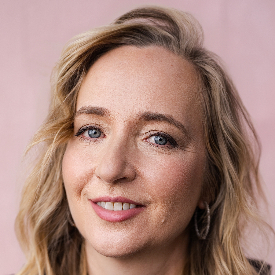
Below, Allison Schrager shares five key insights from her new book, Worth the Risk: The Seven Myths That Keep Us from Taking the Chances We Need to Take.
Allison is a senior fellow at the Manhattan Institute and a columnist for Bloomberg Opinion.
What’s the Big Idea?
Something feels broken in the economy. People feel like they can’t get ahead—and they’re not wrong. But we have the wrong diagnosis. We assume the problem is that we’re overwhelmed by risk: volatile markets, job insecurity, AI threatening everything. The opposite is true. The real problem is that we aren’t taking enough risk. We have a risk deficit, and it’s condemning us to stagnation and keeping us from reaching our full potential.
Listen to the audio version of this Book Bite—read by Allison herself—in the Next Big Idea App, or buy the book.

1. Safety defines risk.
Over the last two decades, economic risk spiked most dramatically during the financial crisis and the pandemic. At those times, we heard a lot about “safety” and the idea that certain assets should be safe, or that we couldn’t resume our normal lives until we’re safe. As an economist who studied finance and retirement, safety always meant something very specific and important. But defining risk is more complicated. For some people, risk means the odds that something bad will happen. For others, it means there’s unlimited potential.
The closest we can come to a cohesive definition: risk is what safe isn’t. Safety defines risk. This is also true in finance. If you look at any asset-pricing formula for a risky asset, it always includes the price of the safe asset. We cannot manage risk in our lives unless we can define what we mean by “safe.”
2. The world has never been safer.
Things feel very risky and fraught right now. Politics seem crazy. AI might take our jobs or kill us all. Jobs might feel less certain. Financial markets are volatile. Who knows what’s happening with our 401(k)? But if you see risk is what safe isn’t, it becomes clear that there are a lot of ways in which the world is getting safer. However, our higher standards of safety are keeping that sense of risk prevalent.
How has the world become safer in the last 15 to 50 years? Wages have become more stable. Barring a recession, the odds of job loss are lower. Recessions have also become less frequent and less severe. We also know how to manage recessions better, so the human cost is lower. Healthcare is expensive and overwhelming, but it is better and more available than ever. By almost every objective measure, daily life is far less dangerous than it once was.
“Our higher standards of safety are keeping that sense of risk prevalent.”
And yet we feel more anxious than ever. That’s because each generation, equipped with more wealth and better technology, ratchets up its expectations for safety. We are progressively more risk-averse than our parents—not because the world is more dangerous, but because we’ve grown accustomed to a level of security previous generations couldn’t imagine. Technology, for its part, is largely designed to make us safer or to measure risk more precisely. As it improves, so does our baseline—and so does our discomfort with anything that falls short of it.
3. Risk isn’t just for the rich.
When I tell people we’re taking less risk, they push back immediately: What about Elon Musk or Jeff Bezos and all these people in Silicon Valley doing outrageous things that expose us to risk? And that’s not wrong—those people are taking enormous risks. That’s why they’re getting rich while the rest of us aren’t. It’s not that they’re gaming the system—they’re taking outsized risks.
Meanwhile, the rest of us have been quietly squeezed out. Wage variability—how much earnings fluctuate year to year—has been trending downward for all but the top five percent of earners. And it’s that same top five percent who are pulling ahead. Historically, wages rose when people took risks, like starting a new business, moving, or changing jobs. But those options have become harder to accomplish.
The result is a self-reinforcing belief system: you can only take risks once everything is in place, once you have enough money, once conditions are perfect. But that’s exactly backward. Some of the best businesses are born during recessions; that was true in the Great Depression and during the pandemic, which saw a boom in new business formation. Risk-taking also motivates us. The biggest source of motivation is resolving uncertainty. Not knowing how a situation will turn out compels us to work harder and push through. Risk is a superpower and a means of getting ahead that the bottom 95 percent has been deprived of.
4. Risk is not just for the young.
We tend to assume risk-taking belongs to the young. Biologically, they’re programmed to seek more novelty and take bigger risks. But that doesn’t mean that they are good at it. Most young people are still learning to distinguish smart risks from foolish ones.
Older people are much better risk-takers. When you look at risks that require deep pattern recognition and judgment—investing, for instance—older people often outperform. At the World Series of Poker, there’s no real correlation between age and winning. That’s because while older competitors may adapt to novel information a bit more slowly, they compensate with wisdom.
“Older people are much better risk-takers.”
We have this idea that you should step back and seek stability as you get older. But risk is important for vitality and purpose at every stage of life.
5. You are actually good at risk-taking.
There’s a substantial body of research in economics and psychology documenting how lousy humans are at risk-taking. We are riddled with biases and fall apart in the face of uncertainty. But consider the obvious counterargument: we’ve thrived as a species for thousands of years despite incredibly risky conditions. That doesn’t sound like a species that’s fundamentally bad at risk.
The problem isn’t our wiring. It’s the mismatch between our instincts and how modern risks are presented to us. We know how to outrun a predator or forage for food. We don’t know intuitively how to deal with cybersecurity or algorithms. Behavioral studies find all kinds of systematic errors in how adults assess risk, but the same researchers find that babies and even bees are quite good at it. The difference isn’t intelligence or maturity. When researchers present risk problems to babies or animals in ways that are natural and intuitive to them, they perform well. Adults get tripped up because modern risk is packaged in ways that are deeply unnatural to our instincts.
“That doesn’t sound like a species that’s fundamentally bad at risk.”
That’s actually good news. It means the solution isn’t to become a different kind of person. It’s to learn to translate new risks into terms our intuitions can work with. Risk isn’t all-or-nothing. There’s always a smarter way to take it—a balanced portfolio beats a bet on the Super Bowl, and the same principle applies across every domain of life. We were built to handle uncertainty. We’ve just lost touch with that in the modern world.
Enjoy our full library of Book Bites—read by the authors!—in the Next Big Idea App: